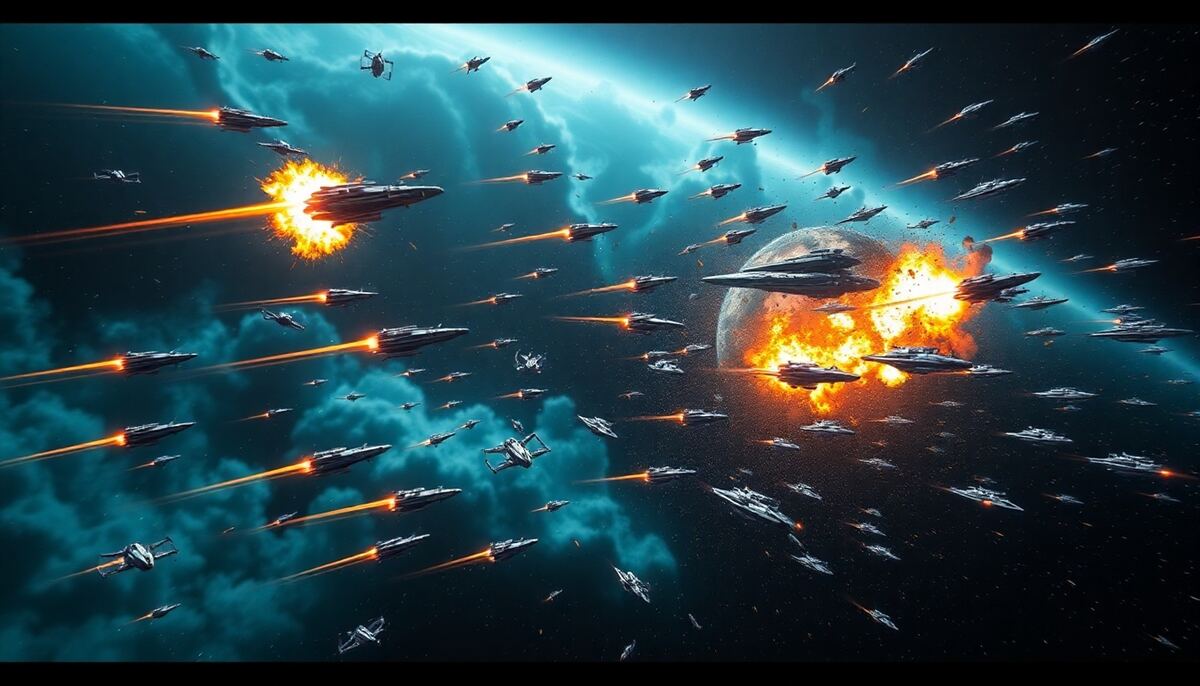
OGame has been running since 2002 and in that time it has generated something most browser games never manage: a genuine culture. There is a shared vocabulary, a set of legendary plays that get retold years after the fact, rituals around fleetsaving, and a hall of infamous forum moments that veteran players still reference. If you have ever seen someone write "ninja'd," "crashed," or "top-fleeter" and felt slightly out of the loop, this piece is for you.
A Game That Created Its Own Culture

Most browser games of OGame's era are gone. OGame survived because the community that formed around it was unusually tight-knit and competitive. The game rewards patience, planning, and social intelligence — and those qualities attract players who invest deeply and talk obsessively about what they are doing.
The result is a lexicon that outsiders find impenetrable. "I crashed a top-fleeter while he was ninja-ing an expedition return and his alliance declared war on the whole galaxy" is a sentence that makes perfect sense to anyone who has played seriously for more than a month. Every term in that sentence has a story behind it.
Speed servers accelerated this culture rather than diluting it. When fleets move faster and resource output multiplies, the drama concentrates. On a 1x universe a top fleet might take six months to build; on a fast OGame universe it can exist within days and be destroyed in an afternoon. The emotional stakes per session are higher, which means the stories spread faster.
OGame culture also lives on the long history of the game itself — two decades of shared reference points that no other browser strategy title can match. When veteran players return after years away, the culture is what pulls them back as much as the mechanics. They want to be part of a conversation that has been ongoing since the early 2000s.
The Legendary Crash: OGame's Defining Drama

Nothing defines OGame culture more than the fleet crash. A "crash" is when an attacker destroys a defending fleet, often while it sits on a planet or moon because the owner forgot to fleetsave, got their timing wrong, or was outplayed. The crashed fleet disappears; the debris field appears; the community talks about it for weeks.
What makes crash stories culturally significant is that they almost always involve a human mistake. The crashed player either trusted the wrong person, was baited, stayed online too long celebrating a raid, or simply set their return timer wrong by one minute. These are relatable failures. The community dissects them not to mock the victim (though there is some of that) but because each crash is a case study in the game's deep psychological layer.
The biggest crashes in OGame history — and there have been some that involved fleets worth billions of points — share common threads: overconfidence, intelligence failures, and someone who was watching quietly for days before striking. The attacker in a legendary crash is almost never someone who got lucky. They did the homework. They watched activity patterns, probed at odd hours, checked the target's alliance for potential recalls, and picked their moment.
The aftermath is equally cultural. "Crash reports" — the combat logs posted publicly — became a staple of OGame forums. Reading a crash report became a skill. Players learned to extract the exact ship composition, the attacker's losses, the debris percentage, and whether the defending player survived with anything. Posting your own crash while staying emotionally composed became a sign of respect in the community. Rage-quitting after a crash became its own genre of comedy.
On modern speed servers like those at OGames, crashes happen faster and with more frequency because fleets are rebuilt quickly. This means the culture around crashes is more forgiving — you can recover — but the raw drama of the moment is unchanged.
Ninja Folklore: The Art of the Counter-Trap
If the crash is OGame's defining drama, the ninja is its defining reversal. A ninja occurs when a defender — about to be attacked — launches their own fleet timed to arrive at their planet after the attacker's fleet lands but before it departs. The attacker finds not a sitting target but a combat at full strength, or worse, a counter-fleet that wipes them out.
The term "ninja" comes from the implied stealth and timing. You do not announce it. You do not give the attacker a chance to recall. You watch the incoming fleet timer, you calculate the return window to the second, and you send your fleet — battleships, bombers, or whatever counter-composition you have — on a mission timed to arrive in that narrow gap. When it works, the attacker loses their fleet. When it fails (miscalculation, lag, recall at the last second), you lose yours.
The ninja is beloved in OGame culture because it turns the power dynamic upside down. The attacker, who presumably scanned you as an easy target, becomes the victim of their own aggression. Forum posts about successful ninjas often go viral within community servers because they carry a satisfying underdog narrative: the small player who turned the tables on a top-fleet aggressor.
There is a sub-genre of ninja folklore around the "double ninja" — where the original defender ninjas the attacker, then a third party ninjas both of them. These are rare enough to be legendary. They require either extraordinary coordination or extraordinary coincidence, and the resulting three-way crash report is always a spectacle.
Defensive players who build their game around the threat of ninja reprisals are sometimes called "ninja baiters." They keep a fleet ready, they stay online when they know someone is watching, and they cultivate a reputation that makes experienced attackers think twice. This is pure psychological game theory inside a browser window, and it has been discussed on OGame forums for twenty years.
Forum Wars, Diplomacy Drama, and the Politics of Space

OGame alliances have always been as much about politics as about combat. The in-game diplomacy system — Non-Aggression Pacts, trade agreements, coalition warfare — generates a social layer that plays out on external forums as much as inside the game itself. This is where OGame culture gets genuinely complex.
Forum wars are a real phenomenon. Two alliances fall out over a crashed fleet, a border dispute, or a perceived slight, and the conflict migrates to the public board. Accusations, screenshots of private messages, leaked spy reports, and counter-accusations stack up into threads that can run hundreds of pages. Veterans learned to read these threads for intelligence: who is lying, who is about to betray their alliance, who is close to quitting.
The vocabulary of OGame diplomacy has its own flavour. "Blue-on-blue" means friendly fire between allied players. "Farming" a player means repeatedly raiding their inactive or low-defence account. "Pushing" means illegally funnelling resources to an ally to boost their ranking, which official servers ban but which creates its own social drama when caught. "Vacation mode camping" describes the passive-aggressive use of vacation mode to avoid being targeted.
Some of the most entertaining OGame stories involve diplomatic betrayal. An alliance officer who secretly spied on their own leadership and sold the fleet positions to a rival. A merger that was announced publicly as friendly while the absorbing alliance quietly prepared to crash the merged members once they disbanded their fleets. These stories circulate for years because they illustrate something true about human nature under competition.
The OGame community also developed its own norms around what is "honourable" and what is not. Crashing someone while they are in a funeral notice period is widely considered poor form. Bashing a single player (attacking them repeatedly beyond the bashing rule limit) generates community hostility even when technical rules allow it. The unwritten social contract is as binding as the written rules for players who want to remain respected in the community. You can learn more about how private servers preserve these community standards better than official servers often do.
Battle Hall: Preserving Legends on OGames
One of the practical expressions of OGame's crash culture is the Battle Hall — a feature on OGames that publicly archives notable combat reports. This is not just a scoreboard. It is a hall of fame with receipts.
On OGames' three universes — Andromeda, Nebula, and Proxima — the Battle Hall surfaces the most significant engagements. A crash in Proxima, where fleets build at 200x economy speed and debris fields return 80% of ships destroyed, can generate a debris field worth more resources than some players will ever mine. When those crashes are preserved in the Battle Hall, they become the kind of reference points that OGame culture runs on. New players see what is possible; veterans measure their own achievements against the record.
The server records system extends this further. Largest fleet destroyed, highest single-combat debris, top expedition haul — these are the statistics that define who matters in a universe. Combined with the Battle Hall, they create a meritocratic fame system that the community takes seriously. The player who holds the "largest crash" record in Nebula will be known by name. That kind of recognition does not exist on most browser games.
This matters culturally because it gives crash stories permanence. On old-school OGame, a legendary crash lived in forum posts and player memory. On OGames, the Battle Hall means the record exists in the game itself. When you register and start playing, you are building toward a record that could outlast any single universe reset.
The combination of the Battle Hall, server records, and the speed-multiplied universe settings means that on OGames, legendary moments happen faster and get documented more reliably than anywhere else. Andromeda's 50x fleet speed still produces genuine tactical depth; Proxima's 200x pace creates a crash-every-week environment where the Battle Hall is constantly refreshed with new contenders.
The Slang Dictionary: Speaking OGame
No culture piece is complete without the language. OGame developed a vocabulary that has remained remarkably stable across two decades and multiple language communities. Here are the essential terms any player should know:
- Fleetsave (FS): Sending your fleet on a long mission so it is in transit and cannot be crashed while you sleep. The most fundamental habit of any serious player. Forgetting to fleetsave is the #1 cause of crashes.
- Crash: The destruction of a fleet in combat. Used as both noun and verb. "He got crashed" means his fleet was destroyed; "the crash" refers to the event itself.
- Ninja: A counter-attack timed to hit an attacker during their landing window. "He got ninja'd" means the attacker's fleet was destroyed by the defender.
- Farmer / Farming: Repeatedly raiding inactive or low-defence players for resources. A legitimate and necessary playstyle, but heavy farming of active players is culturally frowned upon.
- Probe spam: Sending large numbers of espionage probes at a target to gather intelligence, often as a psychological warning or harassment tool.
- Debris field (DF): The resource field left after a battle, collectible by recyclers. On OGames, debris percentages are generous — up to 80% of ship losses in Proxima — making recycling a significant strategic element.
- Top-fleeter: A player ranked highly by fleet points. Being called a top-fleeter is a status marker; losing your fleet drops you off the list overnight.
- Turtle: A player who builds heavy defences and rarely or never sends a fleet. Turtles are safe from crashes but miss out on raiding income and expedition rewards.
- Hunted: Being tracked by an attacker who is watching your activity windows and fleet return times. If someone tells you "you're being hunted," change your routine immediately.
- Ghost (or FS ghost): A fleetsave sent on a mission with no real destination — purely to keep the fleet safe. Common terminology for the protective fleetsave habit.
- Recall: Cancelling a fleet mission mid-flight. Attackers recall when the target ninjas or when they spot an interception. Defenders sometimes recall a ninja attempt if they miscalculate.
- ACS (Attack Coordination System): The in-game mechanic allowing multiple players to combine fleets in a single attack. ACS crashes on major targets are the most epic events a universe sees.
These terms appear in discussions about server speeds and strategy guides alike. Learning them is not just about fitting in; each term encodes a real strategic concept that shapes how you play.
Making Your Own Story on a Speed Server
The culture described above was built by players, not designers. Gameforge created the mechanics; the community created the mythology. That means the mythology is still being created, right now, on every active server.
Speed universes are where the next generation of OGame legends gets written. The compressed timelines mean that the arc from "new player" to "crashed a top-fleeter" to "hall of fame record" can happen in weeks rather than years. This is not a diminishment of the achievement — the skill required is identical, the stakes feel equally real — but the narrative density is higher.
If you want to participate in OGame culture rather than just read about it, the practical steps are the same as they have always been. Learn to fleetsave religiously. Study crash reports to understand how attacks are built. Join an alliance that communicates actively, because the diplomacy layer is where half the real game lives. Build a reputation — either as someone who crashes effectively or someone who punishes attackers who underestimate you.
The question of whether OGame is worth playing in 2026 is answered, in part, by this culture. The mechanics are one reason to play. The fact that a community with twenty years of shared history, shared language, and shared stories is still actively building that history — that is the other reason. Speed servers like OGames' Andromeda, Nebula, and Proxima are the most active arenas for that ongoing story right now.
Private servers in particular have become the keepers of this culture, as private server communities consistently offer the quality-of-life features and balanced settings that official servers have struggled with. The traditions — the crash reports, the ninja stories, the forum debates — travel with the players, not the platform.
FAQ
What does "ninja" mean in OGame?
A ninja is a counter-attack timed to hit an incoming attacker during the brief window when their fleet has landed at your planet but has not yet departed. If successful, your fleet destroys theirs. The name comes from the stealth and precision timing required — you do not reveal what you are doing until the last moment. It is one of the most celebrated plays in OGame culture.
What is a fleetsave and why is it so important?
A fleetsave is sending your fleet on a mission — typically a long-duration one like an expedition, a deployment, or a resource transport — so that it is in transit and cannot be crashed while you are offline. It is the single most important habit in OGame. The vast majority of legendary crashes happened because the victim did not fleetsave or miscalculated their return timer. On speed servers, where fleets are rebuilt quickly, the cost of forgetting a fleetsave is high but recoverable; on slower servers it can mean months of work lost.
How do OGame crash reports work and where can I find them?
A crash report is the combat log generated after any battle in OGame. It shows the attacker's and defender's ship compositions, the outcome, losses on both sides, and the resulting debris field. Players traditionally post these on forums or community channels as evidence of achievements or as learning material. On OGames, the Battle Hall archives notable crashes directly in the game interface, so significant engagements are preserved permanently within the universe rather than depending on players to post them externally.
What is the difference between a turtle and a raider playstyle?
A turtle is a player who invests heavily in planetary defences — plasma turrets, heavy lasers, ion cannons — and keeps little or no fleet. Turtles are extremely difficult to crash because they have no fleet to destroy, but they also generate income slowly since they cannot raid inactive players or run expeditions effectively. A raider keeps a large, fast fleet and generates income by attacking other players and inactives. Raiders are vulnerable to crashes but grow faster when they play well. Most successful players blend both approaches — enough defence to deter casual attacks, enough fleet to raid actively.
Why do players consider some attacks "dishonourable" even when they are within the rules?
OGame has always had a gap between what the rules permit and what the community considers acceptable. "Bashing" — attacking the same player multiple times within 24 hours beyond the server's bashing limit — is a rule violation with consequences. But even within the rules, repeatedly farming a new player who has no way to defend themselves, or attacking someone who has just announced real-life difficulty, generates community hostility. These norms exist because OGame is a long-term social game: if you burn your reputation by being consistently predatory, alliances will not accept you, potential trade partners will refuse, and you will find the community less cooperative when you need help. The social contract is enforced by social consequences, not game mechanics.