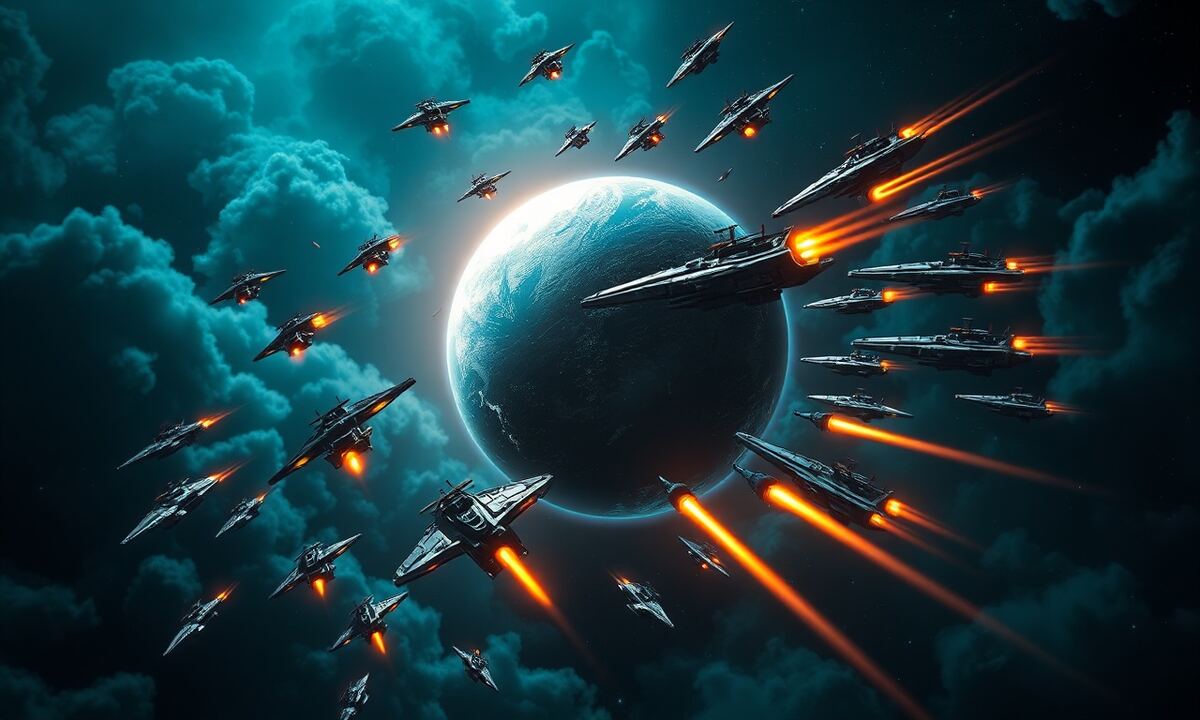
ACS — the Alliance Combat System — lets two or more players combine their fleets into a single landing wave, concentrating firepower that no solo attacker could bring to bear. When your alliance lines up a clean ACS strike, targets that seemed untouchable suddenly become debris fields. This guide walks through every layer of execution: the mechanics, the coordination workflow, the loot rules, and how defenders can try to crack an incoming joint wave.
Hitting Together Hits Harder

The core logic of ACS is deceptively simple: all participating fleets arrive at exactly the same second and fight as one combined force. The combat engine resolves a single battle — one attacker side, one defender side — meaning your fleet's firepower and rapid-fire chains apply collectively. A Deathstar that might struggle against a saturated defense becomes far more effective when allied battleships are soaking up return fire and stripping rapid-fire shields simultaneously.
Beyond raw firepower, ACS unlocks targets that are simply off-limits to solo attackers. A player sitting behind 10,000 Plasma Turrets and a full moon turtle is individually impenetrable. With four or five allied admirals pooling their heaviest hulls, the math flips. This is the real reason ACS exists in OGame's design: it rewards organized communities over solo grinders.
On OGames universes the speed multipliers mean fleets are enormous and battles happen constantly. Andromeda's 50x fleet speed, Nebula's 99x, and Proxima's eye-watering 200x all compress travel windows dramatically. ACS windows that would take hours of coordination in a 1x universe collapse into minutes here — making alliance joint operations a daily occurrence rather than a once-a-month event.
How ACS Attacks Work

The initiating player — the ACS host — sends their fleet toward the target as a normal attack mission, then opens the ACS invite panel and sends join links to their allies. Each invited player selects ships from a planet or moon and assigns them to the existing ACS slot. The fleet missions are now linked: every participant's ships are locked to arrive at the same timestamp as the host's fleet.
A few mechanical realities every participant must understand:
- Arrival sync: The game slows the fastest fleet or accelerates slower ones to share the host's arrival time. All fleets listed in the ACS use the host's mission clock.
- Slot consumption: Each participant burns one fleet slot from their own account. The host burns one slot for the ACS mission itself. Plan your fleet saves around this — you do not want to be short a slot when a juicy ACS invite lands in your inbox.
- Independence of participants: Each ally's fleet travels separately until the moment of impact. Phalanx will reveal individual participant fleets if they are in range; the defender may therefore learn who is coming even if they cannot stop all of them. See our deep dive in the phalanx guide for how intel works both ways.
- No partial retreats: Once the ACS is committed and the slot locked, individual participants cannot recall without exiting the ACS entirely — which returns their ships home but may expose the timing to the host's screen.
- Combat resolution: The engine treats all attacker fleets as one combined entity. Rapid-fire probabilities, shield piercing, and armor checks all happen across the merged pool. One combat report is generated; all participants receive a copy.
Understanding the underlying combat mechanics is essential before you commit serious tonnage to an ACS: if the math does not work (attacker firepower vs. defender hull + defense), adding more slots does not fix a fundamentally losing engagement.
Coordination and Timing

Execution quality separates winning alliances from those who take the debris instead of collect it. Before the first fleet moves, nail down these four coordination pillars:
Target Vetting
Run fresh espionage on the target. Confirm resources on planet and moon, current fleet composition, defense totals, and officer loadout. Check activity timestamps — a target who was active two minutes ago is likely watching. Stale intel kills ACS. Assign one dedicated spy runner; do not rely on three people sending probes simultaneously and spamming the alliance chat with contradictory reports.
Fleet Commitment Declaration
Before the host launches, every participant must publicly commit their exact fleet composition in the coordination channel. Use a structured format: planet/moon of origin, ship types and counts, expected flight time from that origin. The host calculates the slowest fleet because that sets the landing time; everyone faster sets their speed percentage accordingly to match. On Proxima at 200x speed, even a 1% speed difference becomes relevant — be precise.
The Five-Minute Window
Send the ACS invite with enough runway for all participants to join, load their fleets, and confirm. On high-speed universes like Nebula or Proxima, a target who notices phalanx activity has less time to react than on slow servers — but your alliance also has less time to join the ACS slot. Establish a hard cutoff: participants not joined by T-minus X minutes are cut from the strike. Waiting for a straggler who forgot to fleet-save their cargo ships is not worth leaking the arrival window.
Communication Channel Discipline
Use a dedicated combat channel separate from general alliance chat. Flood in the main chat drowns critical timing messages. Keep the combat channel to: intel updates, commit declarations, slot confirmations, and post-battle split discussion. Everything else stays out.
Splitting Loot and Debris

The battle is won. Now comes the part alliances argue about most: who gets what.
Loot Rules
OGame's loot mechanic in ACS distributes plunder proportionally based on cargo capacity present at the target at the moment of battle. This creates an immediate incentive problem: participants who brought heavy battle fleets but light cargo capacity lose out to those who stuffed their ACS slot with Large Cargoes. Good alliances set a convention in advance — either everyone brings a defined ratio of warships to cargo, or the host sends a dedicated cargo wave timed to arrive seconds after the battle resolves.
A practical approach: combat participants keep their combat ships clean (no cargo diluting firepower), and one or two trusted alliance members send dedicated cargo fleets to arrive immediately after the battle timestamp. The cargo wave collects the full plunder and the alliance distributes manually via the marketplace or direct transfers. It requires trust but maximizes both combat effectiveness and collection efficiency.
Debris Field Collection
The debris field generated by the battle belongs to whoever gets recyclers there first — there is no automatic ACS debris split. This is where rivalries inside alliances quietly fester. Establish a recycler dispatch protocol before the strike: designate one recycler coordinator who deploys the alliance's combined Pathfinder and Recycler capacity from the nearest origin point. Debris generated from both attacker and defender losses goes into the field; on OGames servers the debris ratio makes this substantial — up to 80% of ship destruction value in Proxima, 55% in Nebula, 43% in Andromeda.
Post-collection distribution is a social contract. Some alliances split equally among combat participants, others weight by contribution (ships lost + combat contribution estimated from the battle report), others give the debris entirely to whoever supplied the most firepower. Whatever your policy, document it and enforce it consistently. Nothing dissolves alliance cohesion faster than recycler drama after a successful strike.
ACS Defense Counterplay
Being on the receiving end of a coordinated ACS strike is one of the most stressful moments in OGame — and also one of the most teachable. Defenders who understand attacker coordination have real options.
Phalanx Monitoring
If you have a moon in range, run phalanx scans the moment you see espionage probes. An ACS with five participants will show five inbound attack missions from different origins. Each scan gives you a fleet composition and arrival time. Even one participant's timing revealed tells you the exact landing second — all ACS fleets land simultaneously, so knowing one arrival means knowing all of them.
Fleet Save to Miss the Window
The most reliable counter to any incoming fleet is a clean fleet save that returns after the attack passes. On high-speed universes this is straightforward: with 99x or 200x fleet speed, a deployment to a distant moon and back can cover the entire incoming flight window with time to spare. Our fleet save guide covers timing tricks in detail. The key insight against ACS: you only need to outlast the attack; the attackers lose their fleet slot investment whether they hit your fleet or empty planet.
Ninja Defense
A well-executed ninja — sending a defensive fleet to land on your own planet within the incoming ACS's combat second — turns attackers into the ambushed. ACS strikes are harder to ninja than solo attacks because you need to identify the earliest possible arrival from all participants, not just one. Once you have arrival time from phalanx, the ninja window math is the same: a fleet dispatched to arrive at your planet on that exact second becomes a surprise third party fighting on the defender's side. The ninja defense guide details the timing calculations.
Calling Counter-ACS
The highest-skill response: alert your own alliance and organize a counter-ACS that lands on the attacking fleet while it is in transit — either at their home planet (if they left it undefended) or by coordinating your own reinforcement fleet to your planet. This requires your alliance to be active and coordinated, which is precisely why strong alliances are the best defensive tool in the game.
ACS Defense: Coordinating Reinforcements
ACS is not only an offensive tool — allied players can send reinforcing fleets to a defender's planet or moon in the same system. The mechanics mirror offensive ACS: the defending player initiates, allies join, all reinforcing fleets arrive simultaneously. Combined with native defense structures, a reinforced position can absorb or outright defeat attacks that would otherwise succeed against a solo defender.
Reinforcement ACS has a critical limitation: reinforcing fleets that survive the battle are stranded at the defended location until the defender sends them back manually, or the participant recalls individually (if that option is still open). Coordinate return timing in advance — nobody wants to lose their Battleships because they sat on a foreign planet and the host went offline.
On OGames, where server records and PvP activity are tracked in the Battle Hall, well-documented ACS defenses earn community respect nearly as much as offensive strikes. A five-attacker ACS repelled by a coordinated defense is the kind of report that gets shared alliance-wide for weeks.
Organizing Your First ACS Strike
If your alliance has never run an ACS, the learning curve feels steeper than it is. A disciplined first run with three trusted members on a soft target teaches every lesson you need before you scale up to a six-slot operation against a hardened turtle.
- Pick a forgiving target. A lightly defended inactive planet in your galaxy with decent resources visible on recent probes. The goal is to learn the workflow, not to maximize return on investment.
- Assign roles before launching. Host, two combat participants, one cargo coordinator, one recycler. Keep it to five players maximum for the first run.
- Host launches first, slowest. Calculate everyone's travel time from their respective origins. The host launches at the slowest speed that guarantees all participants can join before flight locks.
- All participants join before the halfway point. Joining late compresses the slot window for adjustments. Establish a hard join deadline.
- Cargo fleet launches separately. Timed to arrive 10-30 seconds after the battle second. Do not pack cargo into combat fleets on a learning run.
- Run the debrief. After the battle, share the combat report, discuss what each participant's contribution looked like, talk through the debris collection, and document any surprises. This debrief is how an alliance builds institutional knowledge.
After two or three runs you will have a natural template: standard fleet commit format, a cargo wave convention, a recycler protocol. Scale from there. The alliances that dominate OGames leaderboards did not get there by individual heroics — they systematized coordination until ACS strikes were as routine as morning resource collection.
If you are scouting a return to OGame after a break, ACS is where the game's social depth becomes most apparent. Solo play has a ceiling. Alliance play with tight coordination does not.
FAQ
Can I join an ACS with ships from a moon?
Yes. Ships stationed on a moon can be committed to an ACS slot exactly like ships on a planet. Many experienced players stage their combat fleets on moons specifically to reduce phalanx exposure, since a moon-origin fleet requires the defender to have a moon in the relevant galaxy to scan it. Moon-origin ACS contributions are common practice in mid-to-late game play.
What happens if one ACS participant's fleet is destroyed before landing?
If a participant's fleet is intercepted and destroyed in transit by a third party, that fleet is simply absent from the ACS landing. The remaining participants still land and fight with whatever forces survived. The ACS is not cancelled by the loss of one contributor — it proceeds with whoever reaches the target. This is why large-slot ACS strikes are more robust: losing one participant's contribution hurts less when five others are still arriving.
Does the host lose their fleet slot if an ACS fails?
The host's fleet slot is consumed for the duration of the ACS mission regardless of outcome — win, lose, or draw. Every participant similarly burns one slot each. Slot management is therefore real in active wartime: if your alliance is running simultaneous ACS operations, high-ranking players with Commander-boosted slots become critical coordination resources. On OGames, the Academy's commander system helps mitigate slot pressure for serious fleet commanders.
How is rapid-fire calculated in a multi-fleet ACS?
Rapid-fire rolls happen on an aggregate attacker fleet basis. The game treats all attacking ships across all ACS participants as one combined attacker entity for the purposes of rapid-fire probability checks. This means a Deathstar belonging to one ACS participant generates its rapid-fire against the defender's Battlecruisers as if it were in a solo attacker fleet — the other participants' ships do not interfere with or dilute those rolls. The combined fleet simply means more total rapid-fire opportunities across all your ship types landing simultaneously.
Can an ACS strike be recalled after launch?
The host can abort the ACS mission before the halfway point of the flight, which returns all participant fleets and the host's fleet to their origins. After the halfway point, recall is impossible — the fleet is committed to landing. Individual participants can exit the ACS at any time before the halfway point, which recalls their fleet only; the ACS continues with remaining participants. This is why disciplined alliances set hard join-and-commit deadlines well before the halfway timer — a participant who bails at 49% of flight is a liability, not a surprise.
Ready to put theory into practice? OGames runs three active universes — from Andromeda's 50x speeds to Proxima's 200x chaos — with alliances forming daily and ACS strikes happening around the clock. Register on OGames, join a universe, find an active alliance, and bring your fleet to bear alongside people who know how to coordinate. The debris fields are waiting.