
The Battleship is the single most important combat ship in OGame. It is not the flashiest, not the most feared one-on-one, and it will never one-shot a Death Star — but ship-for-ship and resource-for-resource, nothing anchors a fighting fleet more reliably than a wall of Battleships. Whether you are raiding your first weak inactive or staging a coordinated assault with your alliance, this ship does the heavy lifting. Here is everything you need to know to use it well.
Why Battleships Anchor Every Serious Fleet

Ask any veteran what their core raiding fleet looks like and the answer will almost always revolve around Battleships. The reason is structural: the BS hits hard enough to threaten almost any target, costs enough to build in bulk without bankrupting your economy, and survives long enough in a fight that your fodder layers can do their job.
Compare that to the alternatives at a similar tech level. Cruisers are cheaper but their rapid-fire against Light Fighters punishes you when the enemy has defensive fighters mixed in. Battlecruisers are more efficient against heavy ships but cost nearly twice as much and require a higher tech unlock. Destroyers and Bombers fill narrow niches. The Battleship sits in the sweet spot: broadly effective, widely available, and scalable.
The Battleship is unlocked at Shipyard level 7 (requiring Impulse Drive 4 and Armour Technology 2), meaning it comes online relatively early in a player's development. On a speed universe like OGames, you can reach that Shipyard level within hours of starting, not weeks. This early availability is crucial — it means you are transitioning into real combat ships before your targets have time to turtle behind absurd defenses.
The ship's base stats speak for themselves: 1,000 structural integrity, 200 shield, and 1,000 base attack. Its rapid-fire table is notably clean — it takes rapid fire only from Destroyers (×5) and Death Stars (×30), and those are not ships your typical raiding target has sitting in their fleet. Against the ships you will actually fight — Light Fighters, Heavy Fighters, and Cruisers — the Battleship takes no rapid fire at all. That means every combat round, your Battleships are shooting at full output.
Cost Per Firepower: The Efficiency Argument

Numbers matter in OGame. Every ship you build is an investment, and veterans track cost-per-attack and cost-per-structural-point obsessively when deciding how to spend their resources. Let's look at the raw Battleship build cost: 45,000 Metal / 15,000 Crystal / 0 Deuterium. Compare that against other combat ships:
| Ship | Metal | Crystal | Deut | Base Attack | Shields | Structural HP |
|---|---|---|---|---|---|---|
| Light Fighter | 3,000 | 1,000 | 0 | 50 | 10 | 400 |
| Heavy Fighter | 6,000 | 4,000 | 0 | 150 | 25 | 1,000 |
| Cruiser | 20,000 | 7,000 | 2,000 | 400 | 50 | 2,700 |
| Battleship | 45,000 | 15,000 | 0 | 1,000 | 200 | 6,000 |
| Battlecruiser | 30,000 | 40,000 | 15,000 | 700 | 400 | 7,000 |
| Destroyer | 60,000 | 50,000 | 15,000 | 2,000 | 500 | 11,000 |
Run the arithmetic on attack per unit of Crystal spent — Crystal is the bottleneck resource for almost every mid-game player. The Battleship delivers 1,000 attack for 15,000 Crystal, which is 0.067 attack per Crystal. The Cruiser gives 0.057 attack per Crystal at the cost of Deuterium on top. The Battlecruiser gives 0.0175 attack per Crystal — far worse, despite the shield advantage. Only Light Fighters beat Battleships on this metric, but Light Fighters are fodder ships that die in the first combat round; they are not your damage dealers.
The zero Deuterium cost is the hidden gem of the Battleship formula. Deuterium is universally scarce, required for fuel, research, and your expensive ships. Every Destroyer or Battlecruiser you build is pulling Deuterium away from research labs and fleet fuel. Battleships consume Deuterium only as flight fuel, not as a construction material, freeing your Deuterium economy for other priorities.
Structurally, 6,000 HP per Battleship is significant — exactly six times a Light Fighter's HP. This means your Battleships genuinely survive rounds while your fodder absorbs fire, rather than exploding instantly the moment fodder runs out.
Battleships in Attack and Defense

Understanding how to deploy Battleships correctly in both offensive and defensive scenarios is what separates good pilots from great ones.
Offensive Raiding Missions
In a standard raid, your goal is to arrive with enough firepower to eliminate the defender's fleet and defenses in as few rounds as possible, then collect resources and leave. Battleships excel at this because their high base attack means they one-shot most defenses quickly. A Rocket Launcher has 200 HP. A Battleship hits for 1,000 base attack (before weapon tech bonuses). At Weapons Technology level 10 — which most active players maintain — your Battleship fires for 1,500 attack. That one-shots Rocket Launchers, Light Lasers, and Small Shields cleanly.
The practical implication: when attacking lightly to moderately defended planets, you need fewer Battleships than you might think. Bring enough to clear the defenses in rounds 1-2, and your recyclers can follow to harvest the debris. Over-committing Battleships to weak targets wastes fuel; under-committing costs you ships when defenses survive into round 3.
Coordinated ACS Attacks
In Alliance Combat System operations, each player's fleet fires simultaneously. Battleships scale magnificently here. If your alliance coordinates 10 players each sending 500 Battleships at the same target, you have 5,000 Battleship attacks landing in round 1. Very few defensive setups survive that. The Battleship's lack of rapid-fire vulnerability means every single one of those 5,000 shots fires independently — no attacker is "wasted" because rapid fire ate them early.
Defensive Use on Your Planet
Leaving Battleships on a planet as part of a defensive fleet is valid in OGame, though less optimal than dedicated defenses. The advantage: Battleships left for defense can be recalled and fleetsaved if you detect an incoming attack. Static defenses cannot be moved. Many experienced players maintain a small "stationary defense fleet" of Battleships precisely because it can be recovered from a failed defense — you lose the battle but save the ships. This flexibility has enormous value in the long run.
When defending with Battleships, pair them with plasma turrets and Ion Cannons on the planet. The planetary defenses absorb early fire and deal splash-style damage, while your Battleships deal sustained output across multiple rounds. A defender stack of 1,000 Battleships backed by 200+ plasma turrets will deter all but the most committed attackers.
Pairing Battleships with Fodder
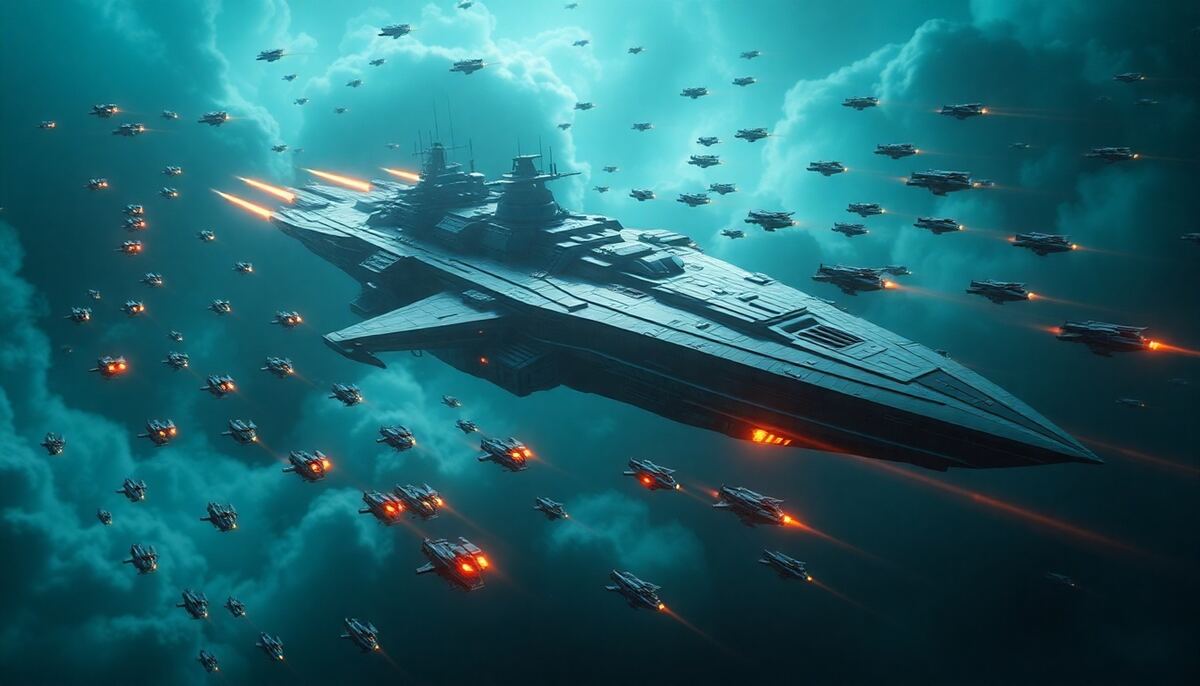
No matter how durable a Battleship is, sending them alone into a defended system is a mistake. This is the concept veterans call "fodder" — cheap ships deployed in front of your expensive ones to absorb enemy fire. The logic is simple: if the enemy has 5,000 attacks to distribute in round 1, you want those attacks hitting Light Fighters worth 4,000 Metal each, not Battleships worth 60,000 resources each.
The standard ratio varies by target, but a widely accepted starting point is 5-10 Light Fighters per Battleship. More specifically:
- Lightly defended planets (mostly Rocket Launchers, Light Lasers): 3-5 LF per BS. Defenses are weak enough that your Battleships clean them in 1-2 rounds anyway.
- Moderately defended planets (Gauss Cannons, Ion Cannons present): 8-12 LF per BS. Gauss Cannons hurt — 2,200 attack at Weapons 0 — so you want them hitting LF, not BS.
- Heavily defended planets (Plasma Turrets, large defensive fleet): Reconsider the attack entirely. If plasma turrets are in play, you may need specialized anti-defense ships like Bombers, or heavy ACS coordination.
Heavy Fighters are a viable alternative to Light Fighters as fodder once you have excess Crystal. They survive longer, meaning you get more rounds of protection per unit. The tradeoff is cost — Heavy Fighters are roughly three times the Crystal of a Light Fighter, so experienced players typically stick to LF fodder unless they have a specific build reason for HF.
Some players also bring Battlecruisers alongside Battleships in larger fleets. Battlecruisers take rapid fire against Cruisers and Battleships the defender might have, which can significantly tilt the outcome in mixed-fleet fights. Read the Battlecruiser guide for the specific rapid-fire breakdown and when that pairing is worth the Crystal cost.
Battleship Weaknesses: When Not to Rely on Them
Experienced players know the Battleship's limits as well as its strengths. Ignoring them leads to expensive losses.
Destroyers Have Rapid Fire Against Battleships
The most dangerous threat to a Battleship fleet is a defender who has invested in Destroyers. Destroyers get rapid fire ×5 against Battleships — meaning every Destroyer fires five times against your Battleships per round instead of once. A defender with 200 Destroyers effectively fires 1,000 times at your Battleships each round. If your fodder ratio is not high enough to absorb those shots, your Battleship fleet evaporates faster than the simulation suggested. Always spy carefully: if you see even 50 Destroyers at a target, either pack heavier fodder or recalculate through the battle simulator.
Death Stars (Graviton) Shred Fleets
Death Stars receive rapid fire ×30 against Battleships. A single RIP fires 30 times at your fleet per round. This is a threat multiplier so severe that a single Death Star supported by a moderate planetary defense can annihilate fleets that would otherwise succeed. Use the OGames battle simulator before any attack where espionage shows a Death Star present. See the Death Star guide for full rapid-fire interaction details.
No Anti-Structure Role Against Large Defenses
Battleships are excellent against fleets and light-to-medium defenses, but they struggle against fortified planets with hundreds of Plasma Turrets. Plasma Turrets have 300 shield and 10,000 HP, but more importantly, they deal 3,000 attack each (before tech). A planet with 500 plasma turrets is dealing 1.5 million attack per round. Battleships are not the right tool for that job — Bombers with their plasma-specific rapid fire bonus are. Reserve your Battleships for planets where defenses are manageable and use specialized anti-defense compositions for fortresses. Check the Destroyer and Bomber guide for those scenarios.
Fuel Costs at Distance
Battleships use Impulse Drive at speed 10,000 base. Their Deuterium fuel consumption per unit of distance is moderate — not as efficient as recyclers, not as expensive as Death Stars. On large galaxy maps (9 galaxies on OGames), cross-galaxy attacks can consume meaningful Deuterium. Calculate your return before launching long-range raids to ensure the loot justifies the fuel expenditure.
The Battleship Era on New Universes
Speed universes change the timeline dramatically. On OGames' Proxima universe at 200x economy speed, you can reach Shipyard level 7 within the first few hours of play. The research requirements for Battleships (Impulse Drive 4, Armour Technology 2) follow shortly after. This means Battleships become your primary combat ship before most players have even established their second colony.
In the early-universe rush, the player who transitions from Light Fighters and Cruisers to Battleships first gains a decisive economic advantage. Inactive players accumulate resources fast on high-economy universes, and a Battleship fleet can harvest far more per mission than equivalent Crystal spent on Cruisers — because Battleships have higher cargo capacity per ship (1,500 units) compared to Cruisers (800 units), making them dual-purpose: combat power and resource transport in one package.
On Andromeda (50x economy), the progression is slower but the strategic calculus is identical. Reach Battleships as fast as your build queue allows. On Nebula (99x), you sit between the two extremes. In all three universes, the Battleship is your primary raiding ship from unlock day through at least the mid-game, when heavier compositions involving Battlecruisers, Destroyers, and eventually Death Stars start to supplement the fleet.
The weekly free Dark Matter on OGames — 1,000 DM on Andromeda, 10,000 on Nebula, 50,000 on Proxima — can be spent on Commander or General class bonuses that increase attack and defense outputs of your fleet. The General class in particular provides combat bonuses that make your existing Battleship fleet punch harder without building a single additional ship. Prioritize that class activation early; it multiplies everything you already have.
One additional point for new-universe timing: the Battle Hall on OGames tracks combat records across all universes. Early Battleship fleets that land dominant kills in the first weeks get logged there permanently. If you are on a fresh universe, move fast — the record books fill up quickly, and the pilots who secured early victories are the ones the server community respects.
FAQ
How many Battleships do I need to start raiding effectively?
There is no universal number, but a practical early threshold is around 50-100 Battleships paired with 500-1,000 Light Fighters. At this fleet size you can clear typical inactive planets with moderate defenses in two to three rounds and collect meaningful resources. Use the battle simulator before each attack to verify losses. As you grow, scale both components proportionally rather than adding Battleships alone.
Should I prioritize Weapon, Shield, or Armour technology for my Battleship fleet?
Weapon Technology first, always. Every level increases all your ships' attack by 10% of their base value. At Weapons level 10, your Battleships fire at 2,000 effective attack instead of 1,000 — a 100% damage increase that costs no additional ships. Shield Technology is second priority because it directly reduces the probability of your ships being destroyed in a round. Armour Technology is useful but generally offers less return than Weapons and Shields for fleet compositions that already include sufficient fodder layers.
Is it worth upgrading to Battlecruisers instead of more Battleships?
Battlecruisers complement Battleships but do not replace them entirely. If you are consistently attacking targets with Cruisers and Battleships in their fleet, Battlecruisers add value through their rapid-fire bonuses against those specific ships. However, the crystal cost is nearly three times higher per unit than a Battleship, and Battlecruisers also require 15,000 Deuterium each to build. The practical recommendation: maintain a core of Battleships as your primary damage dealer and add Battlecruisers as your economy scales to afford them. Read the full Battlecruiser guide before committing resources to a BC build.
What is the best fleetsave method for a large Battleship fleet?
The standard fleetsave involves sending your entire fleet on a Deployment or Expedition mission timed to return after you are active again. Battleships have solid flight speed on Impulse Drive, which gives you fine-grained control over trip length by adjusting speed percentage. Set your fleet to return 5-15 minutes after you plan to log in. Always send with at least some cargo ships to carry resources — a fleet launch strips your planet of value for attackers even if the ships themselves are safe. For Expedition-based fleetsaves, see the dedicated expeditions guide for timing and load recommendations.
Does the character class I choose affect my Battleships significantly?
Yes. The General class provides a direct 10% combat bonus to all military ships including Battleships, effectively giving you more attack and defense output without building additional ships. The General class also reduces fuel consumption for military fleets. If raiding and combat are your primary activities — which they should be if you are heavily invested in Battleships — General is the correct class choice. The other classes (Collector, Discoverer, Miner) provide no direct combat bonuses. On OGames, class selection is combined with Commanders who provide additional specialized buffs, so General + the right Commander stack amplifies your Battleship fleet substantially from early game onward.
Ready to put a Battleship fleet to work? Register on OGames and choose a universe that matches your available time — Andromeda for a measured pace, Proxima if you want to be flying Battleships within the first day. The fleet slots are waiting.